Tenant Improvement Allowances: How to Structure Them Without Giving Away Your Return
June 30, 2026
Investing in San Diego Office Buildings After Remote Work: What the Market Actually Looks Like Now
July 7, 2026
The multifamily versus commercial real estate debate isn’t one that resolves itself with a single metric or a straightforward recommendation. Both asset classes have built real wealth for San Diego investors. Both have also burned those who underestimated what they were getting into. The honest answer is that the better choice depends on your financing position, your risk tolerance, how you want to spend your management energy, and how each asset type tends to behave when the market stops cooperating - which, in any long-term hold, it eventually will.
San Diego adds its own layer to this choice. The market’s supply constraints, its combination of institutional and small private buyers, its coastal economy, and the cost basis of entry all affect how these two asset classes perform relative to what you might read in a national publication. A cap rate or vacancy assumption that holds in Phoenix or Dallas doesn’t automatically translate here, and building a framework without accounting for local conditions is how investors end up with projections that don’t survive contact with reality.
What follows is an analytical overview of the variables that should drive your thinking: cap rate expectations by asset class in this market, the operational demands each will require, how your financing terms can vary depending on which path you take, how tenant concentration risk affects how exposed you are, and how each asset type has historically held up when economic conditions tighten. The goal isn’t to sell you on one over the other - it’s to give you a sharper framework so you can make that call yourself.
Key Takeaways
- San Diego multifamily cap rates average 4.6%, well below the 6.0% national average, leaving investors thin margins for error.
- Commercial financing requires higher down payments, stricter DSCR requirements, and tougher terms for first-time buyers than residential loans.
- Losing one commercial tenant can eliminate 30-50% of income instantly; multifamily vacancy rarely disrupts overall cash flow comparably.
- Multifamily outperformed commercial during both the 2008 recession and COVID, as housing demand provides a more durable income floor.
- The best choice depends on your financing access, risk tolerance, and management capacity-not solely on projected yield.
What Cap Rates Actually Tell You About These Two Asset Classes in San Diego
A cap rate is a property’s annual net income divided by its purchase price - it tells you what return you’d get if you paid cash and had no debt. The lower the cap rate, the more you’re paying relative to the income the property produces.
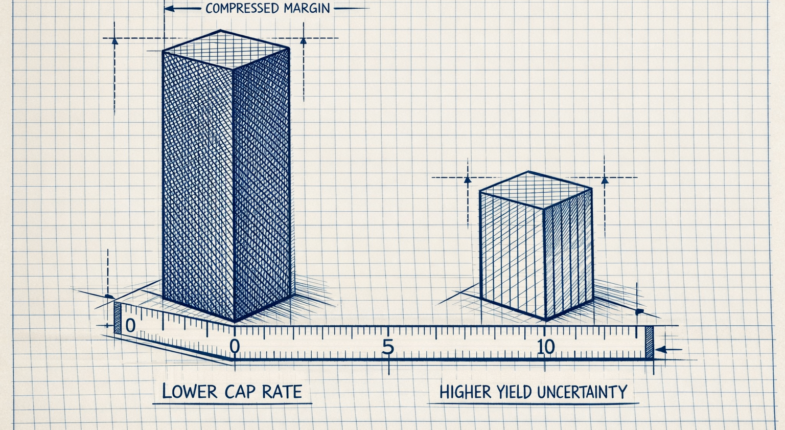
San Diego multifamily properties are trading at around a 4.6% cap rate according to CoStar data. The national multifamily average sits closer to 6.0%, which means San Diego buyers are paying a known premium just to get into this market. That gap isn’t random - it reflects how much investor demand has pushed prices up here.
A compressed cap rate tells you two things at once. First, the asset is in high demand and priced accordingly. Second, your margin for error is thin - because you’re paying quite a bit for each dollar of income the property generates.
If you’re buying a San Diego multifamily property at a 4.6% cap rate, it’s worth asking yourself what has to go right to make that pencil. You’d likely need rents to grow, costs to stay manageable, and some appreciation over your hold period to come out ahead; it’s not impossible in San Diego. But it’s the bet you’re making.
Commercial properties in San Diego post higher cap rates depending on the asset type and location. Retail and office in particular have seen cap rates rise as those sectors work through post-pandemic demand changes. A higher cap rate can mean better income relative to price. But it can also mean the market is pricing in more uncertainty about that income holding steady.
Neither number is automatically good or bad on its own. The cap rate is a starting point for a much bigger conversation about what you’re underwriting and what it can give you. For a deeper look at how these numbers feed into valuation, how commercial properties are valued in California covers cap rates alongside other methods sellers often overlook.
Financing a Multifamily Building vs. a Commercial Property - Where the Rules Change
The financing side of this comparison is where buyers get tripped up. The split happens at unit count. A 1-4 unit residential property qualifies for a conventional mortgage - think 30-year fixed rates, lower down payments, and underwriting that looks mostly at your personal income and credit score. That changes once you cross into 5+ units.
At five units and above, you are in commercial loan territory regardless of whether the building is apartments or retail. Lenders review the deal differently. They want to see the property’s income support the debt on its own, which is measured by the debt service coverage ratio (DSCR). Most lenders want a DSCR of at least 1.20 to 1.25, which means the property needs to bring in 20-25% more income than the loan payment costs each month.
Loan-to-value ratios are tighter in commercial lending too. Where a residential loan might go up to 80% LTV, commercial lenders on multifamily or retail deals in San Diego land between 65-75% LTV. That means more cash to close than buyers plan for.
There is also the recourse question. Residential loans are usually recourse loans, which means you are personally liable if things go wrong. Larger commercial deals sometimes have non-recourse options. But those are usually reserved for experienced sponsors with a track record and strong assets behind them. If you are weighing your options, it helps to understand the difference between bridge loans and hard money for commercial deals.
That last point matters quite a bit if you are buying your first commercial property. Lenders are underwriting the building and you. A first-time commercial buyer with no prior track record will face tighter terms, higher reserves, and more documentation than a person who has closed similar deals before. Multifamily as high as four units is more accessible for newer investors because the residential lending system is built to accommodate them. Working with an experienced commercial real estate agent in San Diego can help you navigate those expectations before you make an offer.
Tenant Concentration Risk - Why a Full Building Can Still Keep You Up at Night
In a multifamily building, losing one tenant is a minor inconvenience. You have a unit vacant for a few weeks, you find a new tenant, and the building keeps humming along. In commercial real estate, one tenant departure can wipe out 30 to 50 percent of your income in a single month.
That gap is worth understanding. A commercial property with two or three tenants sounds diversified until each one controls a large slice of your total rent roll. The math gets uncomfortable fast when a big occupant decides not to renew.
Three things determine how exposed you are to this. The first is lease term length - longer leases mean more income stability. But they also mean bigger disruption when those leases expire all at once. The second is tenant credit quality, which is a question of whether your tenants are financially strong enough to honor those leases through a downturn. The third is rollover risk, which describes when multiple leases come due around the same time and you have to re-lease space in a compressed window.

San Diego’s office market gives a good example of this. Cushman & Wakefield reported office vacancy in San Diego at 15.4% in Q1 2026. That number climbs when tenants consolidate, downsize, or leave - and landlords are left to absorb the gap.

Multifamily doesn’t carry the same structural fragility. A 20-unit building with one vacancy is 95% occupied. A 5,000 square foot retail strip with one empty anchor space could be functionally half-empty even if the other tenants are still paying.
Commercial properties are not bad investments. But the risk profile is fundamentally different. A full building can look healthy on paper right up until a lease expiration date that changes everything.
How Each Asset Class Holds Up When the Economy Turns
History gives us a helpful place to start. During the 2008-2009 recession, commercial real estate took a hard hit as businesses closed, downsized, or stopped signing new leases altogether. Multifamily held up comparatively well because people still needed a place to live even when their finances were under pressure.
COVID told a similar story. Retail and office vacancies climbed sharply as remote work took hold and consumer habits changed. Multifamily in San Diego stayed pretty stable throughout, and Moody’s has since expected San Diego multifamily vacancy to sit around 4.5% - a number that goes well with a market with steady underlying demand.
The reason multifamily tends to be more resilient comes down to something basic. People can stop going to a store or an office building. But they can’t stop needing somewhere to sleep. That human need gives you a floor that commercial properties don’t have.
Commercial assets can produce strong returns in a healthy economy. But a retail or office property can depend on the financial health of its tenants in a way that multifamily does not. If a business shrinks or closes, that income disappears. If a residential tenant moves out, you backfill the unit - usually faster and with less negotiating than a commercial lease renewal.

Your own risk tolerance matters as much as your return targets. A deal that looks great on paper during good times can perform very differently when credit tightens or consumer spending pulls back. Before you stress-test a deal on returns, it’s worth asking how it performs when things get uncomfortable.
Neither asset class is immune to economic pressure. But the floor beneath multifamily tends to be more durable, and in a market like San Diego - where housing demand stays elevated - that durability carries weight in a downturn.
Management Load, Operational Reality, and What First-Time Owners Often Underestimate
A property’s numbers might look great on a spreadsheet. But the management experience is what you actually live with. These two asset classes feel very different to own, and that gap matters more than most first-time buyers expect.
Multifamily comes with steady activity. Tenants move in and out, units need to be turned over between leases, and maintenance calls are part of the schedule. A four-unit building in San Diego might not feel like a full-time job. But it does need your attention on a fairly steady basis. A property manager can take most of that off your plate, though the cost cuts into your returns.
Commercial feels quieter on the surface. Leases are longer, tenants manage more of their own expenses, and you are not fielding calls about a broken water heater at 9pm. That part is real. But commercial ownership has its own weight to carry, and it tends to show up in concentrated moments instead of steady background noise.
Lease renewals in commercial real estate can mean negotiation. Tenant improvement allowances, rent abatement periods, and buildout contributions are all things a landlord may be expected to cover to attract a tenant. That is not a passive process.
Triple-net leases are usually seen as the hands-off ideal, and in stable conditions they can be. But when a tenant vacates a triple-net space, you could be left with a property that needs significant work before a new tenant will even consider it. Re-leasing a vacant commercial space in San Diego takes time and money.
The right question to ask yourself is what kind of owner you want to be. Some owners do well with steady, manageable volume; others are a better fit for longer quiet stretches with tougher problems when they do come up. Neither is easier in an absolute sense. They are just different, and the right fit can depend on your time, your tolerance, and your experience level.
So Which One Do You Buy? The Framework, Simplified.
Before committing to either direction, map the choice against three honest assessments of your own position:
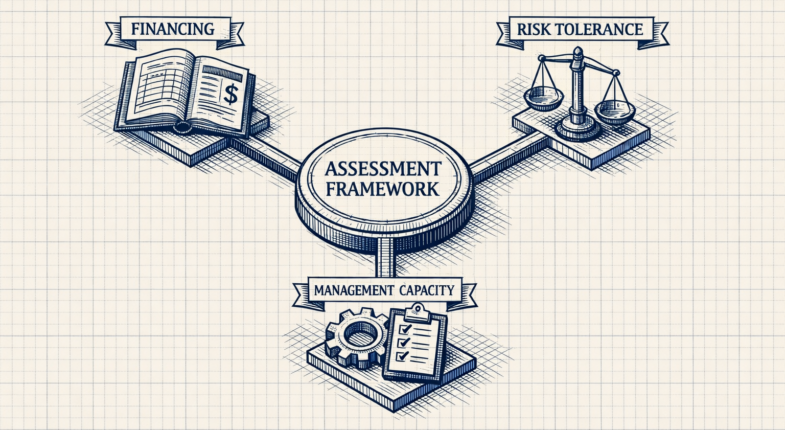
- Financing access: Can you qualify for agency debt on a multifamily asset, or are you working with bridge and conventional commercial loans that carry heavier terms?
- Risk tolerance: Can your cash flow withstand a six-to-twelve month vacancy on a single commercial tenant, or do you need the distributed income of multiple residential units?
- Management capacity: Do you have the infrastructure to handle residential tenancy volume, or is a triple-net commercial lease a better operational fit for where you are right now?
The best deal in San Diego is not necessarily the one with the highest expected yield on paper - it’s the one you can finance on terms that don’t expose you to a forced sale, manage without hemorrhaging time or overhead, and hold through the inevitable rough quarter without flinching. Get that part right first, and the asset class choice largely makes itself.
FAQs
What are typical cap rates for San Diego multifamily properties?
San Diego multifamily properties average around a 4.6% cap rate, significantly below the 6.0% national average. This means buyers pay a premium for each dollar of income generated, leaving thin margins for error.
How does financing differ between multifamily and commercial properties?
Properties with five or more units require commercial loans with stricter DSCR requirements of 1.20-1.25 and lower LTV ratios of 65-75%. First-time commercial buyers also face tighter terms and higher reserve requirements than residential borrowers.
How does tenant vacancy risk differ between asset classes?
Losing one commercial tenant can eliminate 30-50% of income instantly, while a single vacancy in a multifamily building barely affects overall cash flow. Commercial properties with few tenants carry significantly higher concentration risk.
Which asset class performs better during economic downturns?
Multifamily has historically outperformed commercial during downturns like 2008 and COVID, because housing demand provides a durable income floor. Commercial properties depend heavily on tenant business health, making them more vulnerable when economies contract.
Is multifamily or commercial real estate easier to manage?
Multifamily involves steady maintenance and tenant turnover, while commercial is quieter but demands intense attention during lease renewals and vacancies. Neither is objectively easier-the right fit depends on your time, experience, and management capacity.